

Case Study: How to Turn Recipes Into Commerce
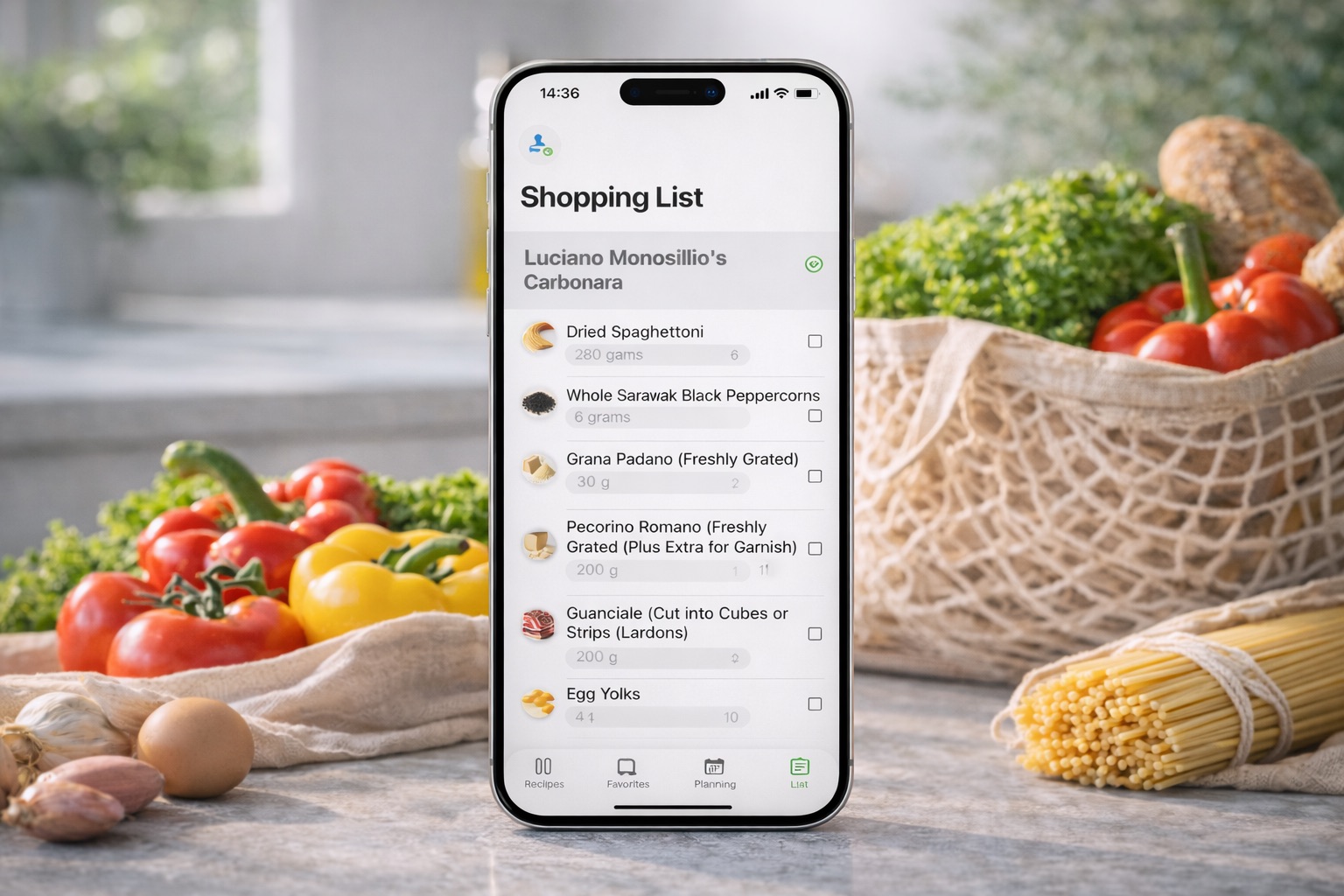
How to Turn Recipes Into Commerce
The Shopping List as the Central Monetization Engine
For years, food publishers have mastered the art of traffic. Now, the opportunity is shifting towards utility. While readers come to your blog for inspiration, the most valuable moment in their journey happens when they decide to cook.
The shopping list captures this moment. It represents high-intent behavior that is planning-driven and naturally closest to the purchase decision.
The Shift
A recipe page is for browsing. A shopping list is for planning. By making the shopping list the hub of your app, you create a natural bridge to commerce that web-only traffic cannot match.
A peer-reviewed study summarizes this role clearly: a shopping list “may function as a concrete action plan for the shopping task.” [1]
The RecipeToApp Solution Stack
We built our white-label platform to operationalize this exact funnel. Here is how our combined App + MyShopping.Help technology turns planning into revenue.
Powered by MyShopping.Help: Your app shouldn’t be a silo. Our technology allows users to paste a URL from any recipe site on the web. We instantly extract the ingredients and merge them into your app’s shopping list. Crucially, we don’t steal views: for the full instructions, we always link the user back to the original source webpage. This makes your app their primary kitchen tool, regardless of where they find inspiration.
Single recipes rarely drive large grocery orders. Our built-in Personal Week Planner allows users to schedule a full week of your meals. One tap consolidates every ingredient into a master list, instantly creating high-value baskets.
The list isn’t just text; it’s a commerce trigger. We integrate department-sorted lists directly with Instacart and other retailers, enabling one-tap affiliate attribution for the entire basket.
The Science of App Conversion
Why move users from web to app? Peer-reviewed research confirms that app adoption fundamentally changes buying behavior.
Paper 1 (ScienceDirect) [2]: App adopters have higher purchase incidence and buy more frequently than non-adopters.
Paper 2 (Marketing Science) [3]: After adopting a retailer’s app, users “buy 33% more frequently and spend 37% more” than non-adopters.
Field Note: We have seen this behavior firsthand in the apps we build for our supermarket clients. The “App Adopter” cohort consistently outperforms web users on frequency and spend.
Our Research Partnership
We don’t just read the science; we help write it. We are an active sponsor and technology partner for PhD Nudging Research at Tilburg University.
We built the dedicated research app used to measure how digital nudges influence healthier grocery choices. The behavioral insights we gain from this academic work are directly applied to the UX of our publisher apps to drive better user decisions and higher conversion.
Beyond Pageviews: The New Scoreboard
Web publishers are used to tracking “Vanity Metrics” like sessions and bounce rates. When you switch to an Owned Audience strategy, your KPI dashboard changes. You stop measuring traffic and start measuring intent.
Here are the specific metrics you can track in an app environment that are impossible to measure on the open web:
- 3rd Party Imports: How many external recipes are users saving to your platform?
- Week Menus Created: The leading indicator of a high-retention user.
- List Completion Rate: The % of items actually checked off (bought).
- Basket Size: The number of items per shop (higher = more commission).
- Shop CTA Taps: The direct conversion event to retailers like Instacart.
- Affiliate Revenue: The bottom line impact of “owning the cart.”
The Bottom Line: From Content to Commerce
The era of passive traffic is fading. The winners of the next phase won’t just be content creators; they will be utility providers.
By combining universal recipe imports, meal plans, weekly planning, and smart shopping lists into one owned experience, you stop fighting for every click and start monetizing every meal.
References
- [1] Thomas, A., & Garland, R. (2004). Grocery shopping: list usage and strategy. Wiley Online Library. [View Study]
- [2] Kim, S. J., Wang, R. J.-H., & Malthouse, E. C. (2015). The Effects of Adopting and Using a Brand’s Mobile Application on Customers’ Subsequent Purchase Behavior. Journal of Interactive Marketing (ScienceDirect). [View Study]
- [3] Narang, U., & Shankar, V. (2019). Mobile App Introduction and Online and Offline Purchases and Product Returns. Marketing Science. [View Study]
